Local Knowledge
What Makes Fish Hawk Trees Different
FishHawk Ranch was built directly into an existing oak hammock rather than cleared and replanted, which means specimen live oaks that predate every house around them now stand a few feet from foundations, pool cages and lanais throughout Starling, Hawk Creek and the original Ranch neighborhoods. Many of those oaks are protected under the county's tree program precisely because they were preserved on purpose during construction, and the CDD and HOA rules layered on top of that make FishHawk one of the most procedurally careful jobs we do anywhere in Tampa Bay. Builder-tight lots leave almost no margin for error once a saw starts.
Trees We Work On Most in Fish Hawk
- Live oak (preserved specimen)
- The reason FishHawk exists in its current form — builders worked lot lines around these oaks rather than removing them, and many now qualify as protected or grand under county rules. We default to reduction, cabling and deadwooding here, since removal usually requires justification and often replacement planting.
- Laurel oak
- Mixed through the original hammock alongside live oak and now aging into the decay-prone stage typical of the species. In FishHawk's tight lots a failing laurel oak sits close enough to a home that we prioritize early inspection over waiting for visible symptoms.
- Southern magnolia
- Planted as ornamental shade in many FishHawk yards, with a shallow, wide root system that can lift pavers and driveway edges over time. Periodic weight reduction on the heavy horizontal limbs prevents splitting at the trunk without removing a tree residents value for its bloom.
- Slash pine
- Standing in pockets throughout the preserved hammock, tall and often closer to rooftops than builders realized once homes were finished. Lightning strikes here kill the tree standing, and a dead pine within reach of a FishHawk roof is treated as urgent.
Preserved hammock oaks feet from the foundation
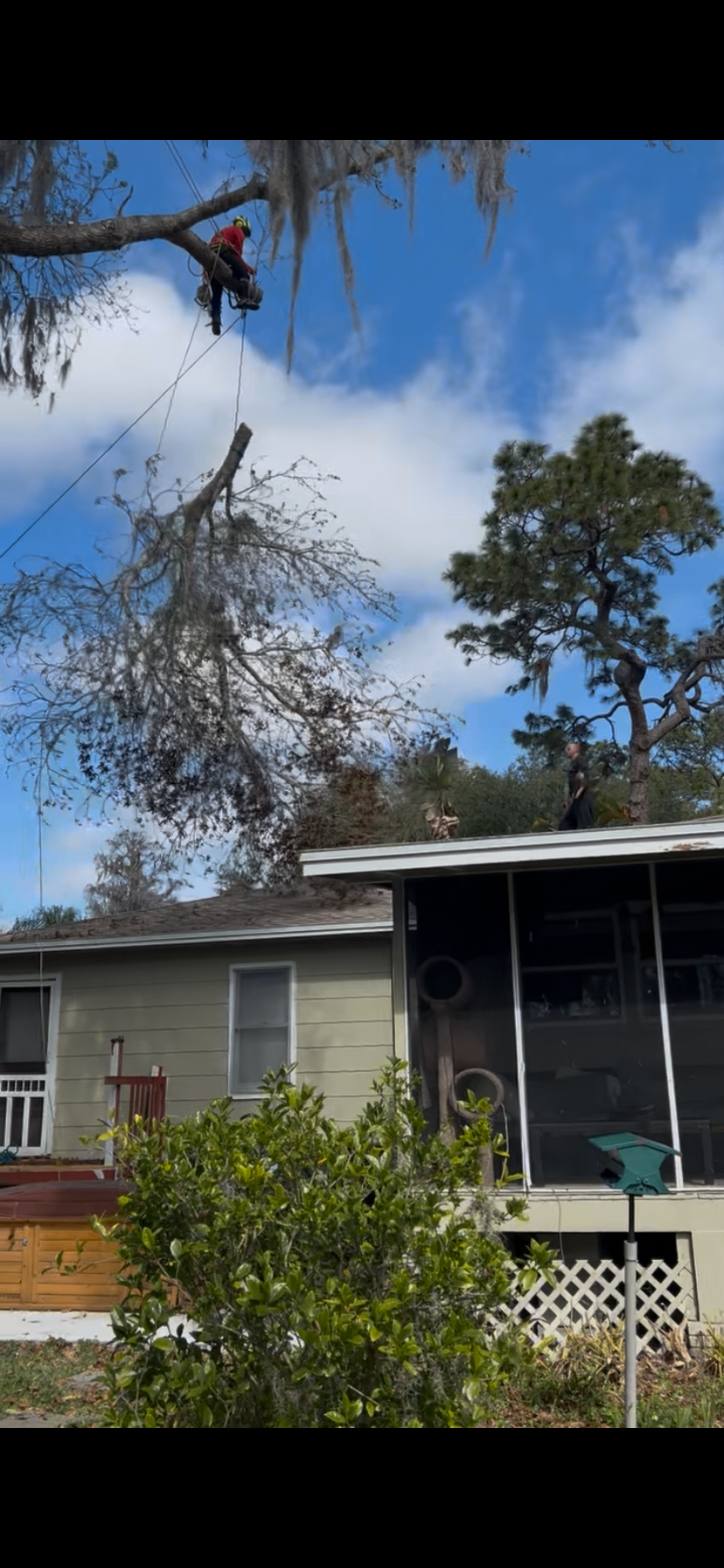
The defining fact of FishHawk Ranch is that its oak canopy came first and the houses were fit around it, which is unusual for a Tampa Bay subdivision and unusually good for the trees, but it also means specimen oaks now stand close enough to touch siding, gutters and pool cage frames. Root zones for these trees are often compressed by construction-era grading and irrigation lines that were installed after the tree, not before it, so a healthy-looking crown does not guarantee an undisturbed root system underneath. We treat every FishHawk specimen oak as a preservation project first and a pruning job second, working with the root zone constraints rather than against them.
CDD and HOA review before anything comes down
FishHawk operates under a Community Development District plus individual village HOAs, and removing — or sometimes even significantly pruning — a specimen or protected oak here usually means clearing county tree review and CDD or HOA architectural approval before work starts. We measure trunk diameter, document the tree's condition and any defects, and provide the paperwork residents need to bring to their association rather than starting work and hoping approval catches up. On builder-tight lots with six to ten foot side yards, we also plan every pick and rigging line around neighboring fences and pool equipment before the estimate is even finalized.
Storm season on a preserved but stressed canopy
FishHawk's hammock oaks are generally healthier structurally than a typical subdivision's builder-planted trees, but decades of construction-era root disturbance and compacted soil around foundations mean some of them carry hidden stress that only shows up under storm load. Post-storm work here is almost always reduction, cabling or targeted limb removal rather than whole-tree removal, since these are the trees FishHawk was built to preserve. We document every recommendation in detail because a protected tree's post-storm treatment plan often needs to be shared with the CDD or HOA as well as an insurance adjuster.