Local Knowledge
What Makes New Port Richey Trees Different
New Port Richey takes the Gulf head on. Gulf Harbors' canal lots deal with salt spray and boat-lift access on top of routine tree work, while the older platted blocks around downtown and Jasmine Lakes carry small lots with big, mature trees that were never sized for the property once they filled in. Much of the city sits low enough that standing water after a heavy rain is routine, and that combination of salt, flooding and tight old lots makes New Port Richey a genuinely different job than the inland Pasco communities a few miles east.
Trees We Work On Most in New Port Richey
- Live oak (canal and downtown lots)
- New Port Richey's older oaks often predate the small lots and additions built around them, with limbs now over garages, seawalls and boat lifts. Salt-laden air off the Gulf and canals stresses the outer canopy over time, showing up as thin, browning leaf edges we check alongside normal structural defects.
- Sand pine
- Common on New Port Richey's drier upland lots away from the canals. Sand pine is shorter-lived and more prone to root rot in poorly drained yards than slash pine, and a pine that has been standing in saturated ground after repeated flooding is a much shorter-odds bet to keep.
- Sabal palm
- Salt-tolerant and common along Gulf Harbors' canal frontage, but boots and old fronds still need regular shaving and removal, especially near boat lifts and seawalls where debris in the water becomes a bigger problem than debris on land.
- Australian pine
- An invasive holdover along some of New Port Richey's older coastal lots, shallow-rooted and prone to snapping or uprooting entirely in wind. We remove these on sight rather than trying to preserve them; they offer little structural value and real storm risk.
- Laurel oak
- Scattered through the older downtown and Jasmine Lakes blocks, now old enough that internal decay is common. On these small older lots a laurel oak failure has a shorter distance to travel before it hits a structure, which is why we treat any base cavity here as urgent.
Salt exposure, flooding and why coastal trees decline differently
Gulf Harbors' canal-front lots and the low-lying stretches near the Pithlachascotee River see salt spray and periodic tidal or storm flooding that inland Pasco trees never experience. Salt exposure shows up first as leaf scorch and canopy thinning rather than obvious structural damage, and repeated flooding saturates root zones long enough to weaken anchoring even in trees that look fine above ground. After any surge or heavy flood event we check New Port Richey trees for soil movement at the base and a newly developed lean before assuming a tree simply needs a trim — flooding-related root failure is a different problem than storm-broken limbs and it needs a different response.
Small lots, canal seawalls and boat lift clearance
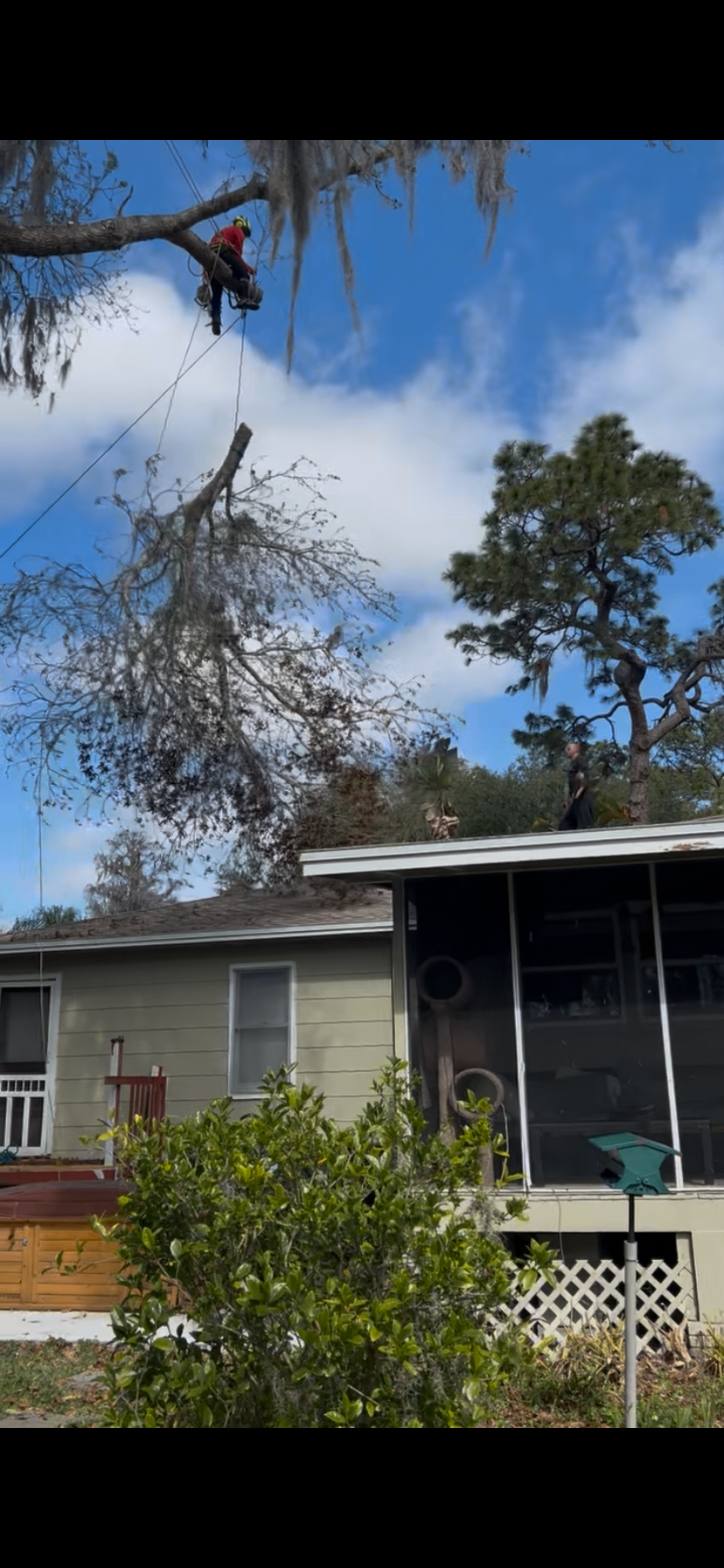
Downtown New Port Richey and the older sections of Jasmine Lakes were platted small, long before the trees on them reached their current size, so most jobs here are tight-access rigging work rather than open-yard removals. Canal-front Gulf Harbors properties add a further constraint: seawalls that cannot carry heavy equipment and boat lifts that debris cannot be allowed to fall on. We plan canal-lot removals to rig sections away from the water and the lift, and on the smallest downtown lots we often carry sections out by hand rather than bring a truck onto ground that has nowhere to turn around.
Storm surge risk and flood-prone streets
New Port Richey's low elevation and Gulf proximity mean tropical systems bring both wind and surge risk here in a way inland Pasco cities do not see, and streets near the river and canals flood before the wind damage even starts. Our storm response plan for New Port Richey accounts for flooded access roads that can delay a crew reaching a property, so during active systems we stage closer to the coast in advance where conditions allow. Once we can reach a property, the priority order is the same as everywhere else — structures and blocked exits first — but getting there is the part that takes longest here.