Local Knowledge
What Makes Largo Trees Different
Largo's neighborhoods were mostly built out in the 1950s through 1970s, and the trees planted alongside those mid-century block homes have now outgrown the yards around them. Camphor and laurel oak went in fast and cheap as shade trees decades ago, and today their shallow roots lift driveways and their limbs sit directly on roofs in Ridgecrest, East Bay and Imperial Point. Belleair and Harbor Bluffs, just south, carry a slightly older and better-kept canopy of live oak on larger lots. Nearly every Largo job we take starts with a side yard too narrow for a truck and ends with a stump that resprouts if we do not grind it properly.
Trees We Work On Most in Largo
- Camphor
- Planted heavily as a fast shade tree in Largo's mid-century subdivisions and now a recurring headache. Shallow, aggressive roots lift slab foundations and driveways, and a camphor cut down without a full grind will resprout from the stump for years. We grind deep and treat the cut face on request.
- Laurel oak
- The dominant older street tree through Ridgecrest and East Bay, now reaching the age where interior decay outpaces canopy appearance. A full crown does not rule out a hollow base, so we inspect the root flare on every mature laurel oak before recommending removal or retention.
- Live oak
- Found on the larger, older lots in Belleair and Harbor Bluffs and worth keeping for decades when it is healthy. We reduce end weight and cable co-dominant leaders instead of topping, which is common bad advice we still have to undo on Largo properties.
- Queen palm
- Common in Largo's mid-century yards, often planted close to the house for quick vertical shade. Heavy seed drop and loose fronds clutter driveways and pool equipment; regular trimming to the horizontal keeps them safe without shortening their life the way a hurricane cut does.
Slab foundations, shallow roots and lifted driveways
Largo's mid-century block homes were built on slab foundations with driveways poured close to the trunk of whatever shade tree came with the lot, and camphor and laurel oak roots planted in that era are shallow by nature. Decades later those roots have lifted slabs, cracked driveways and pushed up sidewalk sections across Ridgecrest, East Bay and Imperial Point. We see this constantly, and it changes the removal conversation — sometimes root pruning on one side buys years, but once a root is structural to the tree's stability or has already cracked a foundation, removal is usually the more honest answer than another round of concrete patching.
Tight side yards and stump resprout problems
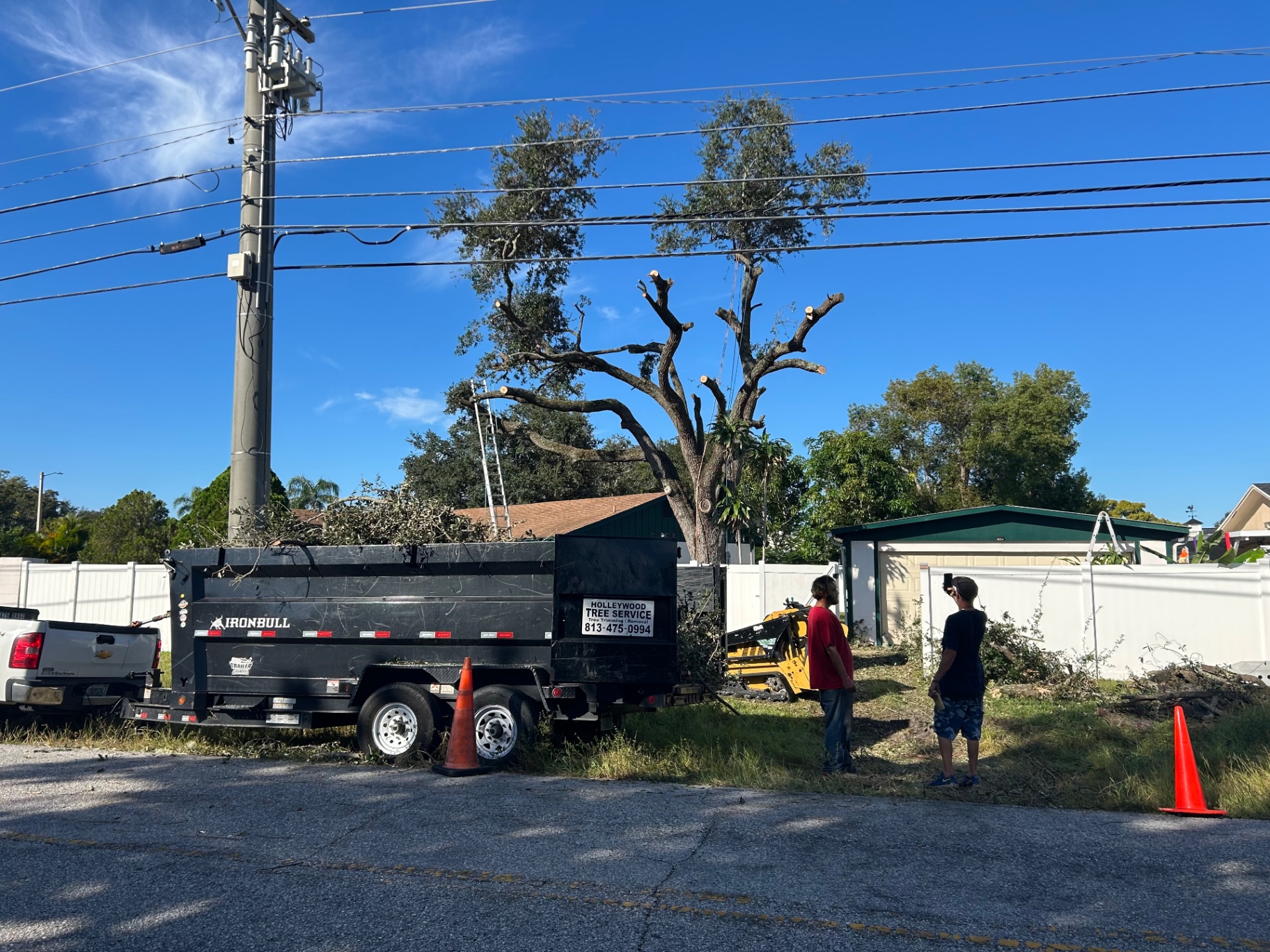
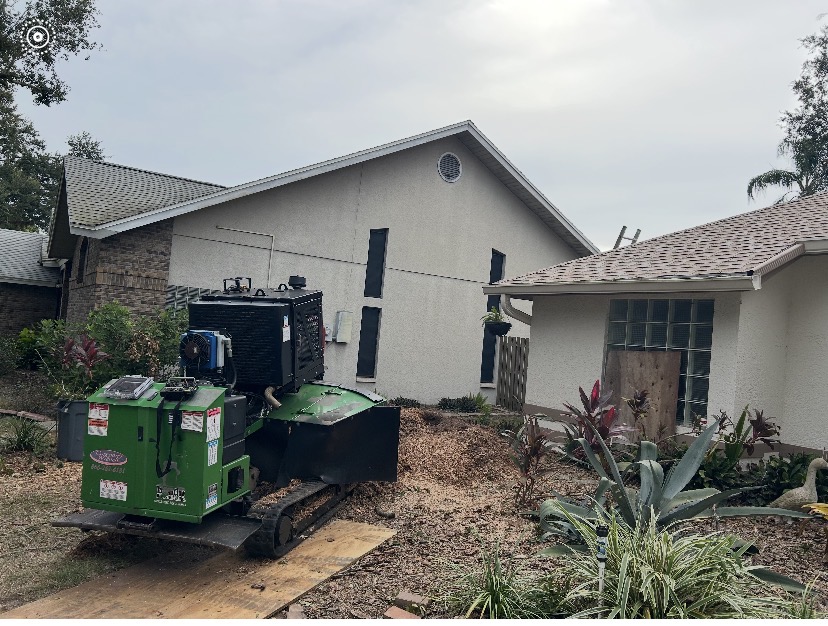
A typical Largo lot from this era gives us five or six feet of side yard between the house and the fence, which rules out driving a stump grinder or a chipper straight to the back. We routinely hand-carry sections and wheel smaller equipment through gates rather than widening access. Camphor in particular punishes an incomplete job — cut the trunk and leave the stump shallow-ground or untreated, and it will send up a thicket of resprouts within a season. We grind Largo stumps deep enough and wide enough that resprouting is not a callback we expect to make.
Storm exposure between Belleair and the Intracoastal
Largo sits close enough to the Intracoastal and Boca Ciega Bay that Belleair and Harbor Bluffs properties take real coastal wind, while the inland mid-century blocks see more standard squall-line damage. Camphors and laurel oaks with roots already compromised by decades of driveway and slab conflict are more likely to go over in a storm than a comparable healthy tree elsewhere, because the root plate was never fully sound to begin with. Post-storm we prioritize anything on a structure first, then hangers, then the cleanup, and we document everything for insurance.