Local Knowledge
What Makes Lutz Trees Different
Lutz is our home base — our shop, our trucks and our crews start every morning here, which is why Lutz gets the tightest scheduling window we offer anywhere in Tampa Bay. It is also one of the more demanding canopies we work in. The older sections around Lake Keystone, Sunset Lane and the Van Dyke corridor still hold mature live oak and slash pine that predate the subdivisions built around them, and those trees now share space with roofs, pool cages, septic fields and power drops that were never part of their original growing environment.
Trees We Work On Most in Lutz
- Live oak (Quercus virginiana)
- The signature Lutz tree and the one we get called about most. Long horizontal limbs pick up enormous end weight, and in sandy Lutz soil the root plate does not always hold what the canopy is carrying. We reduce end weight and cable co-dominant leaders rather than topping — a topped live oak regrows weaker, faster-failing wood.
- Laurel oak (Quercus laurifolia)
- Planted heavily in 1970s–90s Lutz developments and now reaching the end of a short 50–70 year life. Laurel oaks hollow from the inside while still looking full on top, which is why so many 'healthy' trees come down in storms here. We look for basal cavities, mushroom conks and sudden limb drop before we sign off on one.
- Slash and longleaf pine
- Tall, brittle, and unforgiving over a roofline. Pines snap rather than bend, and lightning strikes in Lutz's summer storm belt kill them standing. A pine that browns from the top down after a strike is a removal, not a trim.
- Sabal palm and queen palm
- Common along Lutz driveways and lake frontage. Sabal boots harbor rats and roaches until they are shaved; queen palms drop heavy seed pods that stain drives and clog pool equipment. We trim to the horizontal and never hurricane-cut.
- Camphor and Chinese tallow
- Invasive volunteers that show up along Lutz fence lines and ditch banks. They grow fast, root shallow and fail early. Removing them young saves a crane call later.
Sandy soil, high water and why Lutz trees uproot
Much of Lutz sits on deep sand over a shallow water table, with lake frontage and wetland edges through Keystone, Cheval and the Sunset Lane corridor. Sand drains fast and holds roots poorly. After a multi-day soaking rain the soil loses grip exactly when the wind arrives, which is why Lutz sees whole-tree uprooting — root plate and all — where inland clay counties see limb failure instead. When we assess a Lutz tree we look at the ground as hard as the canopy: soil heaving on the windward side, a raised lip of turf at the root plate, or exposed roots on a lake bank all tell us the tree is already moving.
Working around Lutz lots: septic, wells, pool cages and narrow side yards
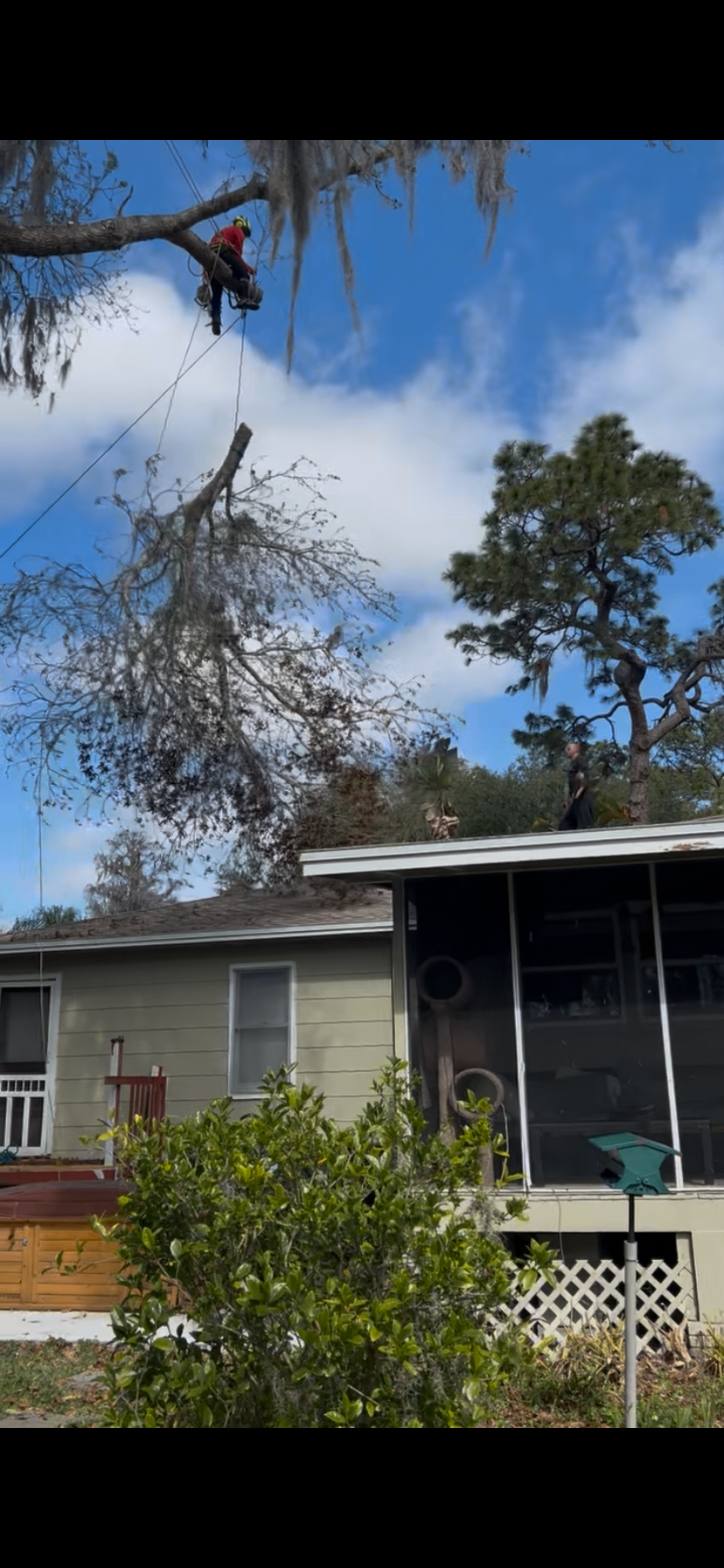
A lot of Lutz property is on septic and well rather than city utilities, and a drain field will not survive a loaded crane outrigger or a fully-laden chip truck. Before we bring equipment onto a Lutz lot we map the tank, field and well head and plan the pick from there — often rigging the tree out in sections over the house rather than driving to it. Older Lutz homes on acre-plus lots frequently have a side yard too narrow for a lift, so trunk sections come down on ropes and get carried out. It is slower, and it is the reason your turf and pavers survive the day.
Storm season on the Pasco/Hillsborough line
Lutz sits in one of the most lightning-active corridors in the country, and afternoon convection through June to September does more cumulative damage here than named storms do. We keep a Lutz storm rotation: standing hazards get cleared first, then roof and driveway obstructions, then cleanup and hauling. Because the shop is in Lutz, our storm response time here is measured in minutes rather than hours, and we photograph every stage so insurance adjusters get clean documentation without you chasing us for it.