Local Knowledge
What Makes Seffner Trees Different
Seffner still feels like the rural crossroads it grew out of, with older lots along Kingsway, Mango and Williams Road holding shade oaks that were left to grow big and wide over single-story block homes and long gravel driveways. These are not builder-planted subdivision trees — many predate the houses beneath them — and their limbs sit low and close over carports, well pumps and power drops in ways a newer neighborhood never would allow. Narrow streets and long driveways mean access is often the hardest part of a Seffner job before a saw ever gets picked up.
Trees We Work On Most in Seffner
- Live oak
- The classic Seffner shade tree, often older than the house it now shelters, with limbs stretched wide and low over rooflines and carports. We reduce end weight and cable major unions rather than remove these outright, since a mature Seffner live oak this size took decades to grow and is usually worth saving.
- Laurel oak
- Common on Seffner's older residential lots and now well into the age where internal decay outpaces what the crown shows. A laurel oak leaning over a single-story roof with a full canopy on top can still be hollow at the base — we check there first.
- Camphor
- A frequent volunteer along Seffner fence lines and old pasture edges. Shallow roots and brittle wood make camphor one of the first trees to go over in a squall, and removing it young avoids a bigger job later.
- Slash pine
- Scattered on Seffner's larger, older lots, standing taller than most of the oaks around them. Pines snap rather than bend, and lightning strikes through Seffner's summer storm season kill them standing before the crown ever browns visibly.
Big oaks, low roofs and tight power drops
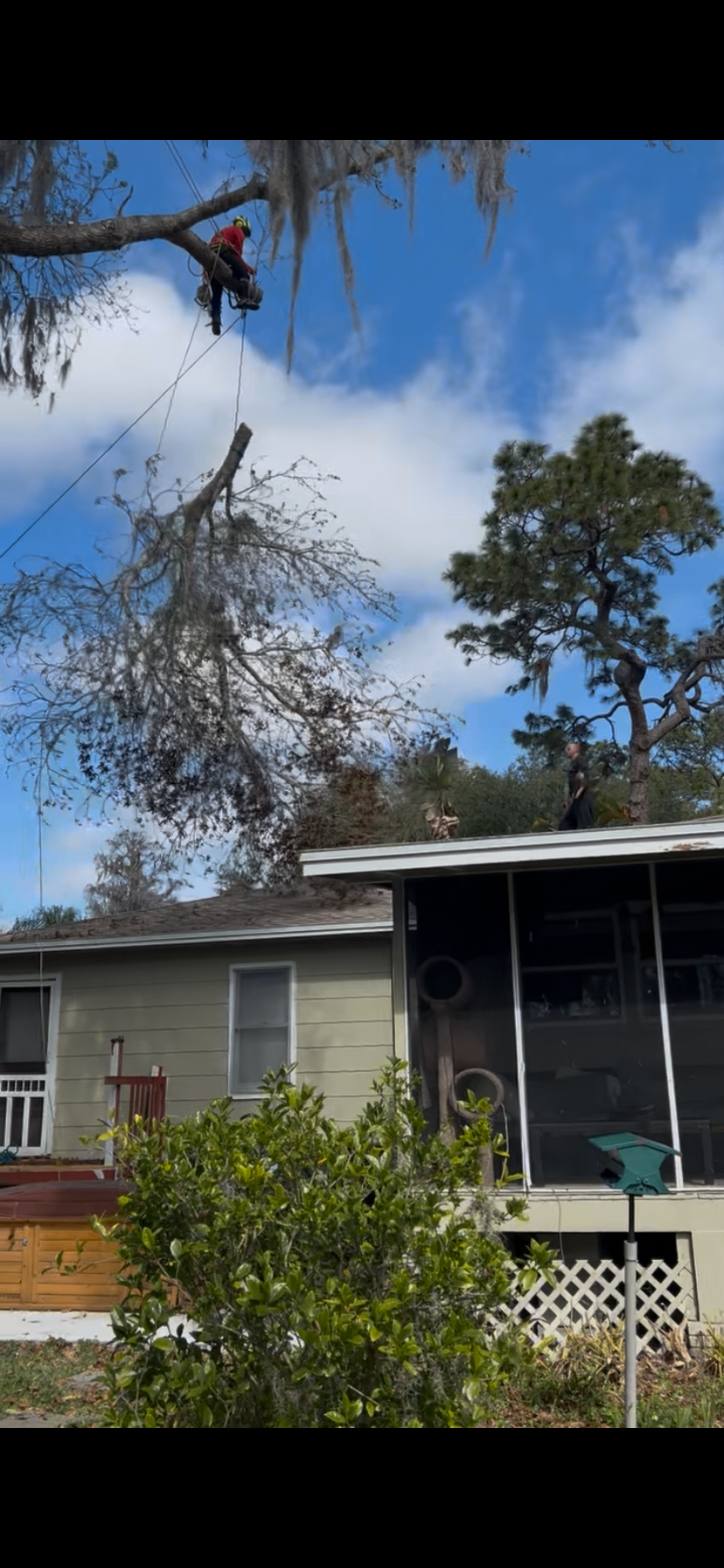
A lot of Seffner's older homes are single-story block construction with rooflines lower than what a newer two-story build would have, which means a mature oak canopy sits proportionally closer to the roof and to the overhead service drop than it would elsewhere. We spend real time on every Seffner job mapping where the drop line runs into the meter before we make a single cut, because clipping a service line here does not just cost a callback, it can cut power to the house. Limbs get worked back from the drop first, then off the roof, in that order.
Long driveways and where the truck can actually park
Many Seffner properties on Kingsway, Mango and the Williams Road corridor sit on long gravel or shell driveways set well back from the road, often shared or narrowed by fencing, sheds and parked equipment that built up over years. Getting a chip truck and crane combination back to the tree is frequently the hardest part of the job, and on some Seffner lots we simply cannot get equipment past the halfway point, which means rigging sections out by hand and hand-carrying brush to the truck rather than dragging it. We walk the driveway with you during the estimate so there are no surprises on job day.
Storm season on Seffner's older canopy
Seffner sits under the same summer lightning and squall activity as the rest of east Hillsborough, and its older, heavier oak canopy tends to drop large limbs rather than fail wholesale the way a younger tree might. Post-storm calls here are mostly about hangers left over carports and driveways after a limb has already partially broken free. We prioritize those first in our response rotation because a hanger over a driveway is what actually hurts someone, and Seffner's narrow streets mean we plan equipment access into the response, not after we arrive.