Local Knowledge
What Makes Westchase Trees Different
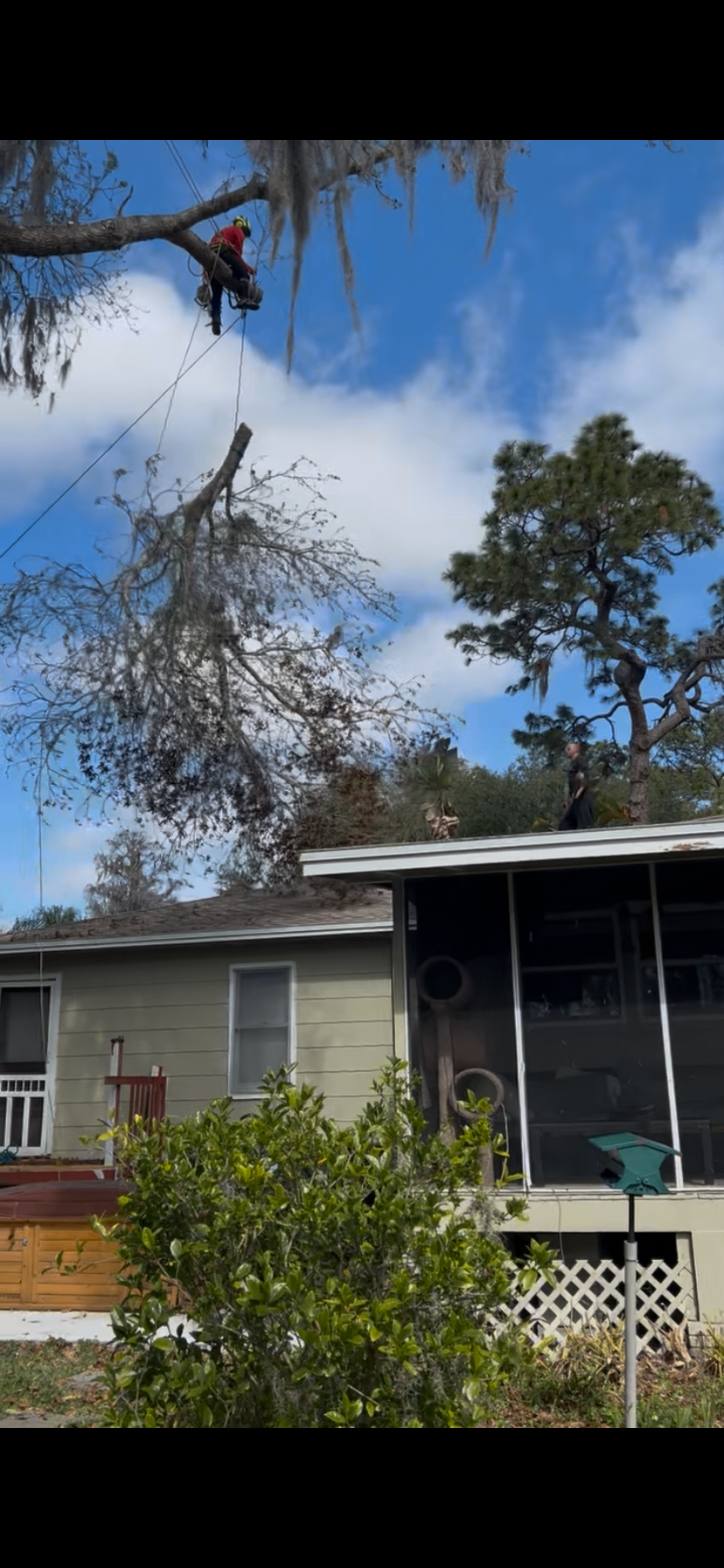
Westchase was built out in the 1990s on tight, zero-lot-line parcels, and every tree job here starts with the same math problem: a mature live oak or laurel oak, a house six feet away on one side and a deed-restricted association on the other. The Greens, Harbor Links, West Park Village, Radcliffe, Stonebridge and Bennington all share the same layout — narrow side yards, shared fence lines, pool cages, and an ARC that expects the work to look right when it is done. Almost nothing in Westchase gets felled; it gets rigged, picked, and carried out in pieces.
Trees We Work On Most in Westchase
- Live oak
- Westchase's primary shade tree, planted at build-out and now large enough to require real planning around every removal or major prune. We reduce end weight and cable co-dominant unions to keep these trees standing, since a mature Westchase live oak is one of the harder trees in the neighborhood to replace at the same scale.
- Laurel oak
- Common through Westchase's older sections and now approaching the age where internal decay becomes a real concern. On a zero-lot-line property a laurel oak failure has almost nowhere to go but a house, a fence or a neighbor's roof, which makes early inspection worth more here than in a neighborhood with more open space.
- Southern magnolia
- Planted in many Westchase front yards for its year-round look, with a wide, shallow root system that can lift walkways and driveway edges over time. Heavy limbs need periodic weight reduction to avoid splitting close to the trunk.
- Sabal palm
- Standard landscaping palm throughout Westchase's common areas and private lots alike. We shave boots to keep pests out and trim seed pods before they drop into pool cages, which is a near-constant complaint on these tightly packed lots.
Zero-lot-line access: no room for equipment to maneuver
The defining fact of a Westchase job is the side yard, which on most lots here is three to six feet between the house and the fence line, often with a utility meter, an AC condenser or a pool cage support squeezed into that space as well. A bucket truck or chipper cannot get to the back yard on most Westchase properties, which means the tree comes out the way it went up: piece by piece, lowered on ropes, carried out by hand, or picked over the roof with a crane staged in the street. We plan every Westchase removal around this constraint before we ever bring a crew, because discovering it on site costs everyone the day.
Deed restrictions, ARC review and shared fence lines
Every Westchase neighborhood operates under the Westchase Community Association's deed restrictions, and several of the individual villages — West Park Village, Stonebridge, Bennington among them — layer additional architectural review on top of that. Pruning that would pass unnoticed in an unrestricted neighborhood can trigger a compliance letter here if it is not done to a visible, consistent standard, so we prune to ANSI A300 specifications, photograph before and after, and send a certificate of insurance to the association or management company whenever the ARC asks for one. Shared fence lines between zero-lot-line homes also mean more of our Westchase calls than most neighborhoods involve two households and one tree.
Wind loading on tightly packed lots
Westchase's density works against it in a wind event. Homes and mature trees sit close enough together that a failing limb or trunk rarely has open ground to land on — it lands on a house, a shared fence, or a neighbor's pool cage screen. That raises the stakes on preventive pruning here relative to a more open suburb, and it is why we push Westchase homeowners toward scheduled reduction and cabling on mature oaks rather than waiting for storm damage to force the issue. Our post-storm Westchase response prioritizes hangers and leaning trees first, precisely because of how little room there is for anything to fall safely.